
A Fylde coast mum says she is at her wits’ end because her daughter is hooked on a so-called ”party drug” which is having a devastating effect on young people across the area – and their loved ones.
The mum-of-two believes that not enough is known about the problems associated with ketamine misuse and how it can wreak havoc on the health of those who get hooked on it.
She wants better education about the issues, including schools, so that the signs can be spotted and the dangers made clear.
It comes as Blackpool Council acknowledges that recreational use of ketamine is on the rise among young people in the town – and concerns have been raised about the serious health implications which are now starting to be noticed.
Across the UK, a multi-university study of coroner’s reports in England, Wales and Northern Ireland between 1999 and 2024 found there were 696 deaths with detections of illicit ketamine in that five year time period, highlighting a steep rise in ketamine-related fatalities.
It is feared that the cheap production and sale costs could be driving increased consumption.
The desperate mum, who is in her 50s, has experienced the trauma as an anguished parent, feeling helpless as her talented daughter struggles with a powerful addiction which is stealing away her dreams and could even potentially kill her.
I wouldn’t wish this on anybody
The mum, who we are not naming to protect the privacy of her vulnerable daughter, says: “I wouldn’t wish this thing on anybody. It is so awful for those who get hooked and so devastating on their loved ones.
“It ruins lives. And yet it just isn’t mentioned or highlighted, so many people don’t even know about it. It is even referred to as a party drug. They couldn’t be more wrong.”
The attraction for people who misuse this drug are clear enough – ketamine is a dissociative anesthetic which has some hallucinogenic elements and usually has the effect of distorting perceptions of sight and sound and makes the user feel disconnected.
To some it can seem that ketamine can banish social anxieties and make an evening of socialising somehow easier and more interesting and enjoyable.
But the traps are waiting; the side effects to health can be horrific, as the persistent use of the drug begins to cause serious damage to vital organs and can leave the user in agonising pain.
And, ironically, many addicts say the most effective painkiller for the excruciating cramps is ketamine itself, forcing the user into a devastating spiral of further organ damage, just to stop the pain.
Chronic ketamine abuse has been known to damage people’s kidneys, liver and bladder, as well as increased heart rate, seizures, high blood pressure and respiratory issues. In some cases, these problms have proved fatal.
A parent’s nightmare
The mum said: “My daughter got hooked on it while she was at college. She wanted to go to university and was doing well,Her tutors said she was on target to get where she wanted. She was talented at drama and wanted to go into that sort of career.
“But then things changed. We noticed that she had started to become disengaged and completely lost interest in her college work.
“Her college got in touch and asked if anything was wrong because they had noticed a change in her. if I mentioned this to her she got verbally aggressive, which just wasn’t like her.
“I noticed she started to lose contact with her friends and this new person would pick her up and she’d disappear for much of the night.What we were seeing was a complete personality change – but not for the better.
“i knew something was wrong, I thought it might be drugs but I didn’t know. I didn’t know anything.”
Then the truth came out that her daughter was using ketamine on a regular basis.
The mum said: “We tried everything. We sent her away to her dad’s to break contact with the new people who were using ketamine and supplying her.
“But when she got home after weeks away, she was using within a day.
“it was her idea to get in a support worker but it didn’t stop her. Then the physical effects started to hit , She lost more than two stone in weight and she kept complaining of getting urine infections and being in pain.. They weren’t urine infections, they were the cramps associated with early-stage organ damage.
“Since I’ve found out about this, I’ve seen what it can do. The damage can be horrific in bad cases, young people having to wear nappies, their lives ruined. Even young people dying in their twenties.
“I just want my daughter to get better.
“Despite everything, she is still using ketamine. It’s already ruining her dreams and hopes. If she doesn’t stop, the next thing it’ll take could be her life, and mine with it. Without my daughter, there is no me.”
What is ketamine?
Ketamine was first developed in the 1960s as an anaesthetic, designed to put patients into a safe state of sedation without the same risks that older drugs carried. It was quickly taken up in both human and veterinary medicine because it could be used effectively during surgery and emergency procedures.
In recent years, very small doses of ketamine and its derivative, esketamine, have also begun to be studied and applied in the treatment of mental health conditions such as depression, particularly when other therapies have failed.
However, because of the accumuative side effects, its use as a recreational drug has become a major problem, although the extent of this is only just beginnng to reach pubic awareness.
In the UK, ketamine is a Class B controlled substance under the Misuse of Drugs Act 1971. Possession of ketamine is illegal and, while supplying or producing ketamine carries even harsher penalties, with a maximum of fourteen years in prison, alongside fines.
What help is available in Blackpool?
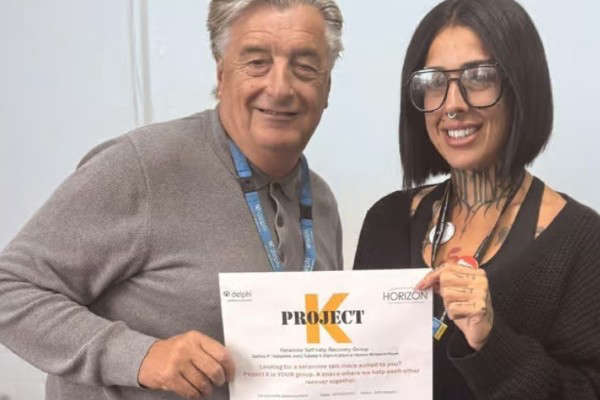
To tackle growing numbers of people seeking support for ketamine addiction in Blackpool, drug and alcohol service, Horizon, have set up a weekly support group.
Taking place at Winstone House every Tuesday, PROJECT K offers a confidential and safe space for people over 18 to talk about addiction and sensitive health issues.
The idea came from client feedback, with Horizon recovery practitioners Steve Dartnell and Mollie Wilson recognising the need for a dedicated group.
Recovery practitioner, Mollie Wilson, explained: “From what we’ve seen, ketamine use is most common among 18–35 year olds. There are no face-to-face, peer-led groups in the area – that’s why we started PROJECT K for anyone over 18”.
PROJECT K will provide a completely safe space for current users or people in recovery from ketamine, empowering them to openly speak to each other about the mental and physical symptoms of using ketamine. Providing education, training and specialist support from Multi agencies working together.
Recovery practitioner, Steve, added: “Ketamine is quite different to most other substances in its culture of usage, as well as effects it has on the mind and body. That’s why it is pivotal to have a group that is specific”.
Chronic ketamine abuse has been known to damage people’s kidneys, liver and bladder, as well as increased heart rate, seizures, high blood pressure and respiratory issues.
He continued: “One of the main symptoms ketamine use is bladder damage, which is why many users seek a safe space for honest conversation with people who understand their situation”.
The group is open to anyone over 18 and not just Horizon service users. The sessions are run on a drop-in basis, with no booking required.
Ketamine, which comes as a clear liquid or white/off-white powder, was originally developed as a medical anaesthetic. Today, while still used in hospitals and veterinary medicine, it is increasingly misused recreationally – leading to rising health and social concerns in Blackpool and beyond.
The Horizon service is funded by Blackpool Council to provide a wide range of drug and alcohol support for all Blackpool residents. They offer information, health screenings, treatments (including opioid substitution therapy) and counselling – all confidential and free.
When is the support group held?
The support group takes place every Tuesday at Winstone House, 199 Church St, Blackpool FY1 3TG.
Time: 5:30pm – 6:30pm
 A world-renowned nightclub has entered administration.
 Blackpool firm named in Times top 100 tech firms in UK
 Avanti bids to revive lunchtime weekday train from Blackpool to London
 MP set for crunch meeting over Norcross roundabout
 Man banned from ASDA, TESCO & ALDI stores across Lancashire
 Arc Cinema signs already up but now given retrospective planning approval